


Latest News

Animal testing? Yes, but…
Camille De Rede October 20th, 2014 No Comments
(photo: Thomas Cueni)
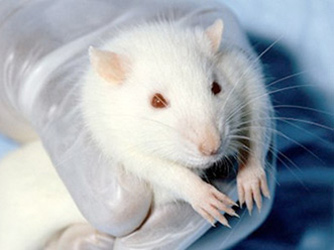
The Swiss are somewhat sceptical about animal testing so they use other methods for research purposes. This unsurprising stance was most recently shown in a representative survey of 1000 Swiss voters conducted by gfs.bern on behalf of Interpharma. However, when asked whether animal testing should be banned even where universities, CHESTER TRAVEL GUIDES , and pharmaceutical firms have no other means of advancing research, only 34 per cent of respondents said it should be banned whereas 58 per cent would accept animal testing in such circumstances. There was greater consensus – 70 per cent – regarding approving animal testing for general medical research with research into drugs for the treatment of diseases. There has been barely any change to this critical but approving stance since the last survey in 2009. This is unsurprising considering much medical progress has its roots in animal testing – like the knowledge of the three neuroscientists awarded the Nobel prize in Medicine last week.
It has a lot to do with the conviction of a significant majority of those surveyed – 55 per cent – that Switzerland has a strict animal welfare law. Only 22 per cent of respondents consider animal welfare in Switzerland to be too lax. The remainder do not know or are undecided. They are very capable of deciding however, when it comes to where animal testing should take place. 91 per cent of those surveyed consider it preferable to allow animal testing under strict conditions in Switzerland than for it to be outsourced abroad to where regulations are less strict.
This critical but favourable opinion of animal testing is also the result of efforts by animal welfare organisations, lawmakers and researchers in Switzerland. Instead of the sometimes radical but unsuccessful opposition to animal testing in the 80s and 90s, there is now dialogue. Undeniable progress has been made. The laboratory animal welfare charter, which Interpharma firms adopted in 2010, is not just attracting interest in Switzerland. The industry is recognising that the legitimate interests of animal welfare campaigners should not simply be pushed aside. However, animal welfare organisations and the research-driven pharmaceutical industry continue to evaluate the necessity of animal testing differently. They agree that animal testing should only be carried out when there is no alternative and authorisation has given following careful weighing of the suffering and distress caused to the animal against the expected gain in knowledge.
As such, both sides – the industry and animal welfare organisations – strongly support a national research programme that should increasingly develop alternatives to animal testing following the principles of the 3Rs. These aim to reduce animal testing, replace it as much as possible with alternatives such as computer simulations, testing cells and tissues and refine methods to minimise the stress caused to the animals. This is widely supported in Switzerland: 83 per cent of respondents were in favour of a research programme exploring alternative methods to animal testing. This wish must be taken seriously, particularly given the importance attributed to animal welfare in Switzerland.
About Thomas Cueni
Thomas B. Cueni is Secretary General of Interpharma, the association of the Swiss pharmaceutical research companies. He is a member of the Board and Council of the European Federation of the Pharmaceutical Industries’ Associations (EFPIA) and of the International Federation of Pharmaceutical Manufacturers Associations (IFPMA). Prior to his appointment with Interpharma, Mr. Cueni had a career as an economic and political journalist for two leading Swiss newspapers and spent four years as a London correspondent. After that he joined the Swiss Foreign Service as a career diplomat with postings in Vienna (UNIDO, UN, IAEA) and in Paris where he was a member of the Swiss Delegation to the OECD. Mr. Cueni has a degree in economics (University of Basle) and a Master of Science from the London School of Economics.
Report: Putting animal welfare principles and 3Rs into action – 2012 Update
Camille De Rede January 22nd, 2014 No Comments
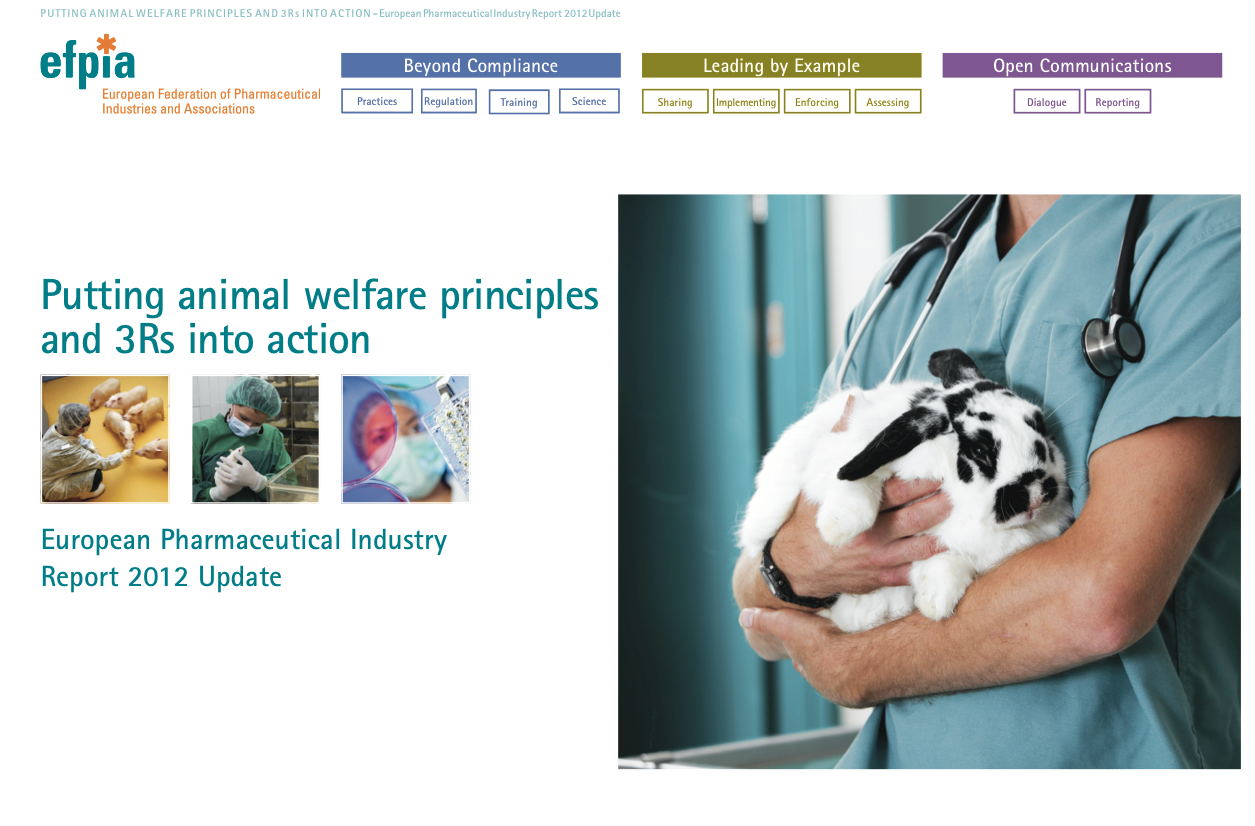
Putting animal welfare principles and 3Rs into action
European Pharmaceutical Industry Report 2012 Update
Beyond Compliance:
- How do we ensure that animal welfare standards and practices are put into action throughout the sector both in our industry and among the laboratory and research community more broadly?
- How do we make sure that global regulations reflect 3Rs strategies?
- What internal and external industry initiatives facilitate the implementation of training programmes on animal welfare and care?
- How do scientific advances help progressing 3Rs and Welfare? *New
Leading by Example:
- How do we share and encourage good practices based on 3R principles across the pharmaceutical industry?
- How do we stimulate putting into practice global animal welfare standards?
- What is being done to rapidly implement and enforce across Europe the revised European Directive 2010/63/EU on the protection of animals used for scientific purposes?
- Are companies independently assessed on how animal welfare standards are applied?
Committing to Open Communication:
- How do we contribute to an open and constructive dialogue on animal welfare?
- How is industry communicating the progress made with animal welfare activities, specifically the 3Rs?

Getting back into the swing of things with Nobel Prize News
Camille De Rede October 15th, 2013 No Comments
It’s been some time since we’ve written but we’ll now be getting back to regular updates. Last week’s big Nobel Prize announcement for medicine/physiology seemed the perfect opportunity to kick things off again. The award went to three scientists who discovered how cells in the body transport material – research with major potential implications for progress in areas like diabetes and brain disorders
So why is the Nobel Prize inspiring a blog, here? As with most Nobel Prize research, animal studies were integral to the researchers’ success. In this case, yeast, cows and genetically modified mice were involved in the research process. Looking back, nearly all Nobel Prizes in Physiology or Medicine have required some form of animal research. According to Americans for Medical Progress, in the past 34 years, all awards but one have been dependent on animal research.
The impact of this year’s prize-winning discovery could be big news for patients suffering from diabetes or brain disorders. The three researchers discovered that vesicles – membranous structures that store and transport cellular products – transport these materials to a precise target, similar to a fleet of ships. This is crucial to many processes – from the release of hormones in the body to brain communication. Defective vesicle transport systems are associated with diabetes and brain disorders – and knowing more about them could help us improve treatment options in these areas.
So congratulations to James Rothman, Randy Schekman and Thomas Sudhof for their Nobel Prize win, and for bringing research a step further.
What are your thoughts on the big Nobel Prize news? Let us know in the comments section below

Whoosh! There goes another deadline
EFPIA Administrator January 23rd, 2013 No Comments
 “I love deadlines. I love the whooshing noise they make as they go by.”
– Douglas Adams
It had all been going so well. The path EU legislation must navigate is notoriously complex. Consultations, proposals, amendments – input from MEPs and compromises between national governments – the road is long and winding.
But for the EU’s directive on how animals are used in medical research, this lengthy process appeared to have produced a compromise which governments agreed would raise standards of animal welfare, reduce red tape by harmonising rules across Europe, and promote the 3Rs.

Controversy over animal transport
January 14th, 2013 No Comments
 I’ll be honest: I had never given much thought to how animals are transported to laboratories for scientific research projects.
It was only when animal rights groups began to put pressure on airlines and ferry companies to stop transporting laboratory animals that this came to our attention.
Researchers are concerned that research on non-human mammals, as well as studies involving frogs, insects and fish, could be hampered if companies refuse to transport animals which will be used in labs. This, according to scientists, could even disrupt the fruit fly research used to study genetics.

Could pharma’s problem redefine animal research?
December 14th, 2012 No Comments
 While many medical needs still remain unaddressed, the number of new therapies and preventions is decreasing.
The reasons for this are many and varied. For one thing, the low-hanging fruit was picked a couple of decades ago so the diseases for which we now need new therapies are the most difficult to treat. This requires a huge investment of time, effort and resources and call for a more collaborative approach to innovation.
For another thing, the cost of conducting research has risen at a time when the rewards are on the wane. A recipe for new drugs it is not.
Yet the world is facing fresh public health challenges due to shifts in demography and lifestyle. Our ageing population means conditions such as Alzheimer’s will become a much greater burden. At the same time diabetes rates are through the roof in develop – and in developing – countries across the world.

Animal research: a global issue
December 3rd, 2012 No Comments
Medical research is a global endeavour regulated locally. Researchers move, patients move – even animals move (sometimes) – and ideas, of course care little for borders. But could more be done to agree common standards for animal research and for validating non-animal testing models?
Well, yes. International cooperation is climbing steadily up the agenda as scientists and policymakers from Europe, the US, China, Brazil and elsewhere share their views on how to support medical progress while making meaningful strides forward towards the 3Rs – reduction, refinement and replacement.
The role of animal testing in orphan drug development
November 22nd, 2012 No Comments
 Much of the debate over the use of animal testing in drug development is a cocktail of facts, emotions and ethics. Regulators have tried to strike a balance between these factors in the forthcoming EU Directive 2010/63/EU, but there is still considerable pressure to stop animal testing altogether. What would happen to drug development, and where would it take place, if animal testing were banned? It’s difficult to find the ‘right’ answers, particularly when rare, or orphan, diseases are involved.
Orphan diseases, affect not more than 5 in 10000 people, With some 29 million sufferers in the EU;

EU research funding: going, going….gone?
November 16th, 2012 No Comments
 Whether you’re in favour of animal research or you would prefer more research on non-animal experimental models, this one is for you.
The EU research budget – a major source of support for medical science – is under serious threat and could be about to fall victim to a much wider political spat over public spending.

Out of the lab and into the debate
November 8th, 2012 No Comments
 Scientists are mobilising in an effort to have their voices heard in discussion of animal research
As part of our ‘Shall it stay or shall it go?’ campaign we’ve been asking you about the future of animal research in Europe.
Well it seems that some of the scientists who work in this area have given their verdict: they want it to stay and are more than a little worried about what they see as myths around animal studies.

The EU, animal research and the Nobel Prize
October 30th, 2012 No Comments
 So, unless you’ve been living in a cave without wi-fi you’ll probably have heard that the European Union has be awarded the Nobel Peace Prize.
The EU also celebrated last week when Professor Serge Haroche, the recipient of a European Research Council (ERC) grant, picked up the Nobel Prize for Physics. Europe plans to increase ERC funding from €7.5 billion to €13 billion from 2012 to help “the very best researchers to conduct pioneering research across Europe”.

Research on dogs: a Catch-22 for animal welfare advocates
October 25th, 2012 No Comments
 During the summer an Italian court ordered the temporary closure of one of Europe’s biggest dog breeding companies.
After an intense campaign by policymakers and animal rights groups, the Green Hill animal breeding firm closed its doors, having handed more than 2,500 dogs over to animal rights campaigners in line with the court ruling.
Activists – and plenty of ordinary tweeters who just love dogs – celebrated. If you almost never give much thought to animal research, a headline about dogs in Italy being saved rather than sacrificed looks like good news.
But could the Green Hill story prove to be a pyrrhic victory for animal rights campaigners?

Does Europe want to be a research hub?
October 19th, 2012 No Comments
 Listen to just about any European politician these days and you are guaranteed to hear some or all of the following keywords: ‘jobs’, ‘growth’, ‘innovation’, and ‘research’.
Read the Europe 2020 strategy and the Innovation Union policy and the message from EU policymakers is clear. Europe says it needs to be in the Premier League of scientific R&D, not just because research delivers solutions that help improve our lives, but because we want to develop and produce things that have value; things people in the US, Japan, China and elsewhere will buy from us.
Rhetoric vs reality
But what is the reality behind the rhetoric? And is Europe sending mixed signals about its support for research?

Why we breed transgenic animals for research
September 12th, 2012 4 Comments
 In our research labs we use genetically altered animals, usually mice, to test scientific theories which we hope will one day lead to new medicines and treatments. In terms of my own work, we create mice with trisomy, which means they have an extra copy of a certain chromosome. In humans, trisomy 21, otherwise known as Down syndrome, is probably the most well-known of these conditions.
The goal is to find ways of alleviating the symptoms of these conditions. We look at how trisomy changes neurological mechanisms and how it influences embryonic development, stem cells, and the programming and function of cells. We identify and target these mechanisms and hope to treat them through therapeutic drugs. These mechanisms are often similar to those affecting humans with comparable conditions.

Annual lab animal statistics: does counting add up?
August 1st, 2012 2 Comments
As European governments begin implementing EU rules on the use of animals in research, new figures reveal that the UK – a leading player in medical science – used more lab animals last year than at any time in the past three decades.
Some 3.8 million procedures were carried out on animals including dogs, cats, mice and monkeys last year, according to press reports.
The numbers are less important than the trend. The total figure is the highest since 1981.